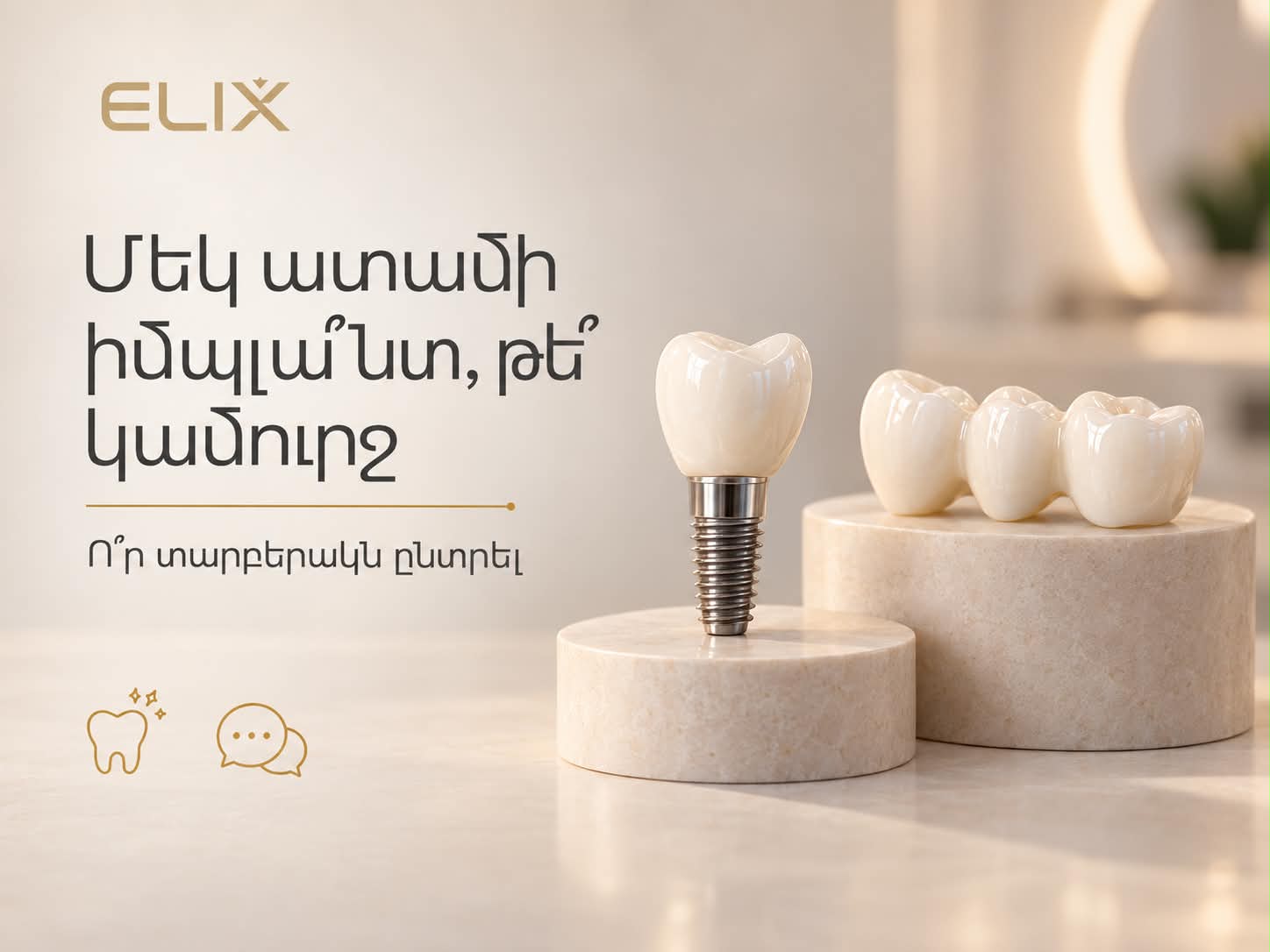
Single Tooth Implant or Bridge: Which Option to Choose?
A missing tooth is not merely an aesthetic issue. It can affect chewing function, and over time, changes may occur in the adjacent teeth and the area where the tooth is missing.
Common options for replacing a single missing tooth include dental implants and dental bridges.
Both methods have their specific indications, advantages, and limitations; therefore, the treatment option should be selected after an assessment of the specific clinical situation.
How is a missing tooth restored with an implant?
In the case of an implant procedure, a dental implant is placed into the jawbone, serving as a foundation for the artificial tooth-the crown. One of the features of single-tooth implantation is that the missing tooth can be restored without using adjacent healthy teeth as supports for a bridge.
However, the feasibility of implantation depends on an assessment of the bone tissue, gums, oral cavity, and overall health.
What is a dental bridge?
A dental bridge is a fixed prosthetic restoration that fills the space of a missing tooth.
In the case of a traditional bridge, adjacent teeth serve as supports and are prepared accordingly for the prosthetic procedure.
In certain situations, a bridge may be a suitable treatment option-for instance, when the adjacent teeth already require significant restoration or prosthetic work. Are adjacent teeth prepared for an implant?
A key feature of single-tooth implantation is that adjacent teeth are typically not used as supports.
With a traditional bridge, the structure relies on adjacent teeth, which must be ground down accordingly.
However, the choice of treatment is not determined by this factor alone.
Is there a difference regarding the bone tissue?
After the loss of a tooth root, the bone tissue in that area can change and diminish over time.
An implant is placed into the jawbone and transfers functional load to that area. A traditional bridge restores the visible part of the missing tooth but does not involve placing a root or implant into the jawbone.
Which treatment option is faster?
The duration of treatment can vary significantly. Implantation may involve a surgical procedure and a period for the implant to integrate. In some cases, additional procedures—such as bone tissue restoration—are also required.
In certain situations, bridge-based prosthetics can be completed in a shorter timeframe. However, the specific timeline depends on the condition of the oral cavity and the abutment teeth.
Implant or bridge: how to choose?
There is no single option that is best for every patient.
When making a choice, the doctor considers the location of the missing tooth, the condition of adjacent teeth, bone tissue volume, gum health, general health, the potential duration of treatment, and the patient's individual needs.
If the adjacent teeth are healthy, preserving them can be a key factor when considering implantation. If the adjacent teeth already require significant restoration, the assessment of treatment options may differ.
It is best to make the final choice after a dental examination and personalized treatment planning.
Frequently Asked Questions
Which is more suitable for a missing tooth: an implant or a bridge?
There is no single answer. The choice depends on the condition of the adjacent teeth, bone tissue, gum health, and the overall clinical situation.
Are healthy adjacent teeth ground down for an implant?
In the case of a single-tooth implant, adjacent teeth are typically not used as supports. With a traditional bridge, however, adjacent teeth serve as supports and are prepared accordingly.
If the adjacent teeth are already damaged or require crowns, might a bridge be a suitable option?
In some situations, yes. The condition of the adjacent teeth is a key factor when choosing a treatment option.
If there is insufficient bone for an implant, does that mean a bridge must be chosen?
Not necessarily. First, the actual condition of the bone tissue must be assessed. In some cases, bone regeneration followed by implantation is possible.
Which treatment option is faster?
Prosthetic restoration using a bridge can sometimes involve a shorter treatment process. Implantation may require surgical and healing phases.
Which lasts longer: an implant or a bridge?
The lifespan of both options is influenced by numerous factors, including hygiene, the condition of the tissues, the load applied, the specifics of the treatment, and regular dental check-ups. It is not possible to specify a single timeframe that applies to all patients.
Do implants and bridges require different care?
Yes. While proper daily hygiene is essential in both cases, the cleaning techniques and the need for additional hygiene aids may differ.
Do implants and bridges require different care?
Yes. While proper daily hygiene is essential in both cases, the cleaning techniques and the need for additional hygiene aids may differ.
Should the choice between an implant and a bridge be based solely on price?
Price can be one of the factors in making a choice, but it is also necessary to consider the condition of adjacent teeth and bone tissue, the treatment process, and long-term maintenance requirements.