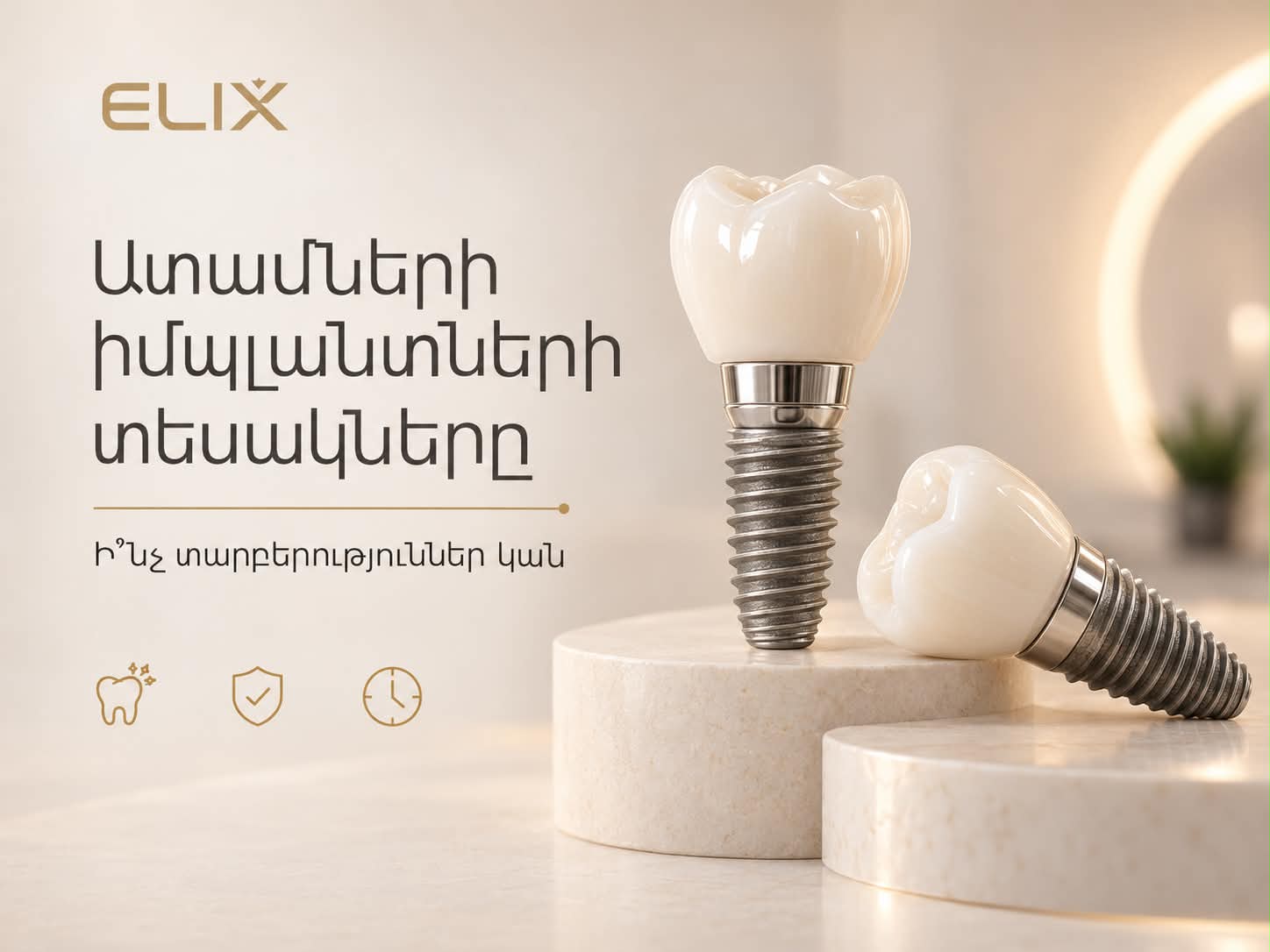
Types of Dental Implants
Dental implantation is a modern method for replacing missing teeth. However, the term "dental implant" does not imply that the same design is used in every case. Implants vary in terms of structure, size, surface characteristics, material, and application.
The choice of implant is made on an individual basis, taking into account the location of the missing tooth, the condition of the jawbone, the type of planned restoration, and other clinical factors.
Most implants are made of titanium or titanium alloys—materials widely used in implantology due to their biocompatibility.
Zirconia-based implants are also available; their suitability is determined based on the specific clinical situation.
Endosseous Implants
Endosseous implants are among the most common types. They are placed directly into the jawbone.
Most modern endosseous implants feature a screw-like design. Their length, diameter, shape, and surface characteristics vary depending on the manufacturer, the implant system, and the specific clinical requirements.
The appropriate implant is selected based on initial diagnostics and treatment planning.
Standard and Narrow-Diameter Implants
Implants also vary in diameter and length.
In certain clinical situations-such as when space is limited—implants with a smaller diameter may be used. However, a narrow-diameter implant is not simply a "smaller version" that can be used in any case.
The choice depends on the volume of bone tissue, the location of the tooth being replaced, the expected load, and other treatment factors. Implants for replacing single or multiple teeth
If a single tooth is missing, a single implant can be placed to support a standalone crown.
When several adjacent teeth are missing, it is not necessary to place an individual implant for every missing tooth. In some cases, multiple implants can serve as supports for an implant-fixed bridge.
The specific treatment plan is determined on an individual basis.
Implants for full-arch restoration
In cases of complete or near-complete tooth loss (edentulism), implants can support either fixed or removable prosthetic restorations.
Various treatment approaches are used, including full-arch restoration supported by multiple implants. Options include the "All-on-4" and "All-on-6" concepts.
Here, too, the number and placement of implants are determined not only by the patient's preferences but also by an assessment of jaw anatomy, bone tissue, the bite (occlusion), and the planned prosthetic restoration.
Titanium or zirconia implants?
Titanium has been widely used in dental implantology for many years. There is a vast amount of clinical data and a wide range of implant systems available for titanium implants.
Zirconia implants offer a metal-free alternative, though their indications and applications may differ from those of titanium systems.
Therefore, the choice of material should be based not merely on marketing claims but on the specific clinical situation.
How does the dentist choose the type of implant?
When selecting an implant, the dentist evaluates the volume and condition of the jawbone, the number and location of missing teeth, adjacent anatomical structures, gum health, the bite, and the intended prosthetic solution. As a rule, a 3D imaging scan is performed, and the resulting data is used to plan the implant procedure.
Therefore, there is no single "best implant" for every patient. It is important to select an implant system and treatment plan that are appropriate for the specific clinical situation.
Frequently Asked Questions
Which type of dental implant is best?
There is no single best implant for all patients. The choice depends on the bone tissue, the location of the missing tooth, the planned restoration, and other individual factors.
Does the implant brand matter?
The implant system manufacturer is an important factor, but the treatment outcome is not determined by the brand alone. Proper diagnosis, treatment planning, placement technique, and aftercare are also crucial.
Should I choose a titanium or a zirconia implant?
Both materials are used in modern implantology, but they have different characteristics and clinical applications. The choice should be made in consultation with the implant specialist after an assessment of your individual situation.
How many implants are needed for a single missing tooth?
Typically, a single missing tooth can be restored using one implant and a crown, provided clinical conditions allow for it.
If multiple teeth are missing, is a separate implant required for each tooth?
Not necessarily. In some cases, several implants can serve as supports for an implant-supported bridge.
Are All-on-4 and All-on-6 types of implants?
It is more accurate to view them as treatment concepts for full-arch restoration, in which the prosthetic appliance is supported by the corresponding number of implants.